
ProductPass · DPP Insights
EU Digital Product Passport Registry: How It Works and What Businesses Need to Know
A practical guide to the EU DPP Registry: what it is, what gets registered, how the registration process works and what manufacturers should evaluate when choosing DPP solutions.
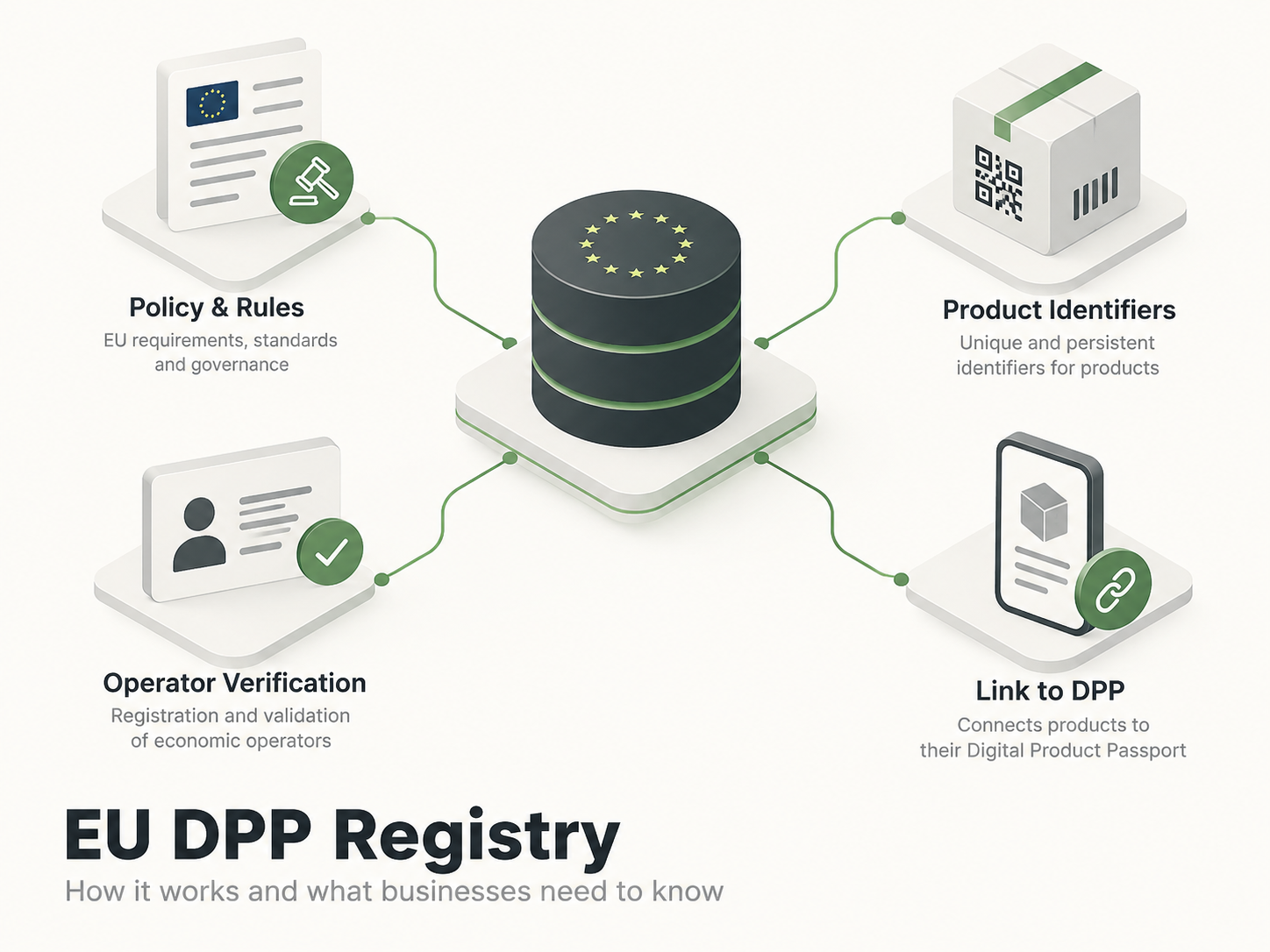
At a glance
- The Registry is an EU-managed registration layer.
- The Passport may be hosted by the responsible operator or an authorised provider.
- Registration creates evidence of the registration event and a unique registration identifier.
Why it matters
The Registry connects product identifiers, verified actors, registration information and regulatory processes such as customs-related checks and future interoperability requirements.
What happens after a Digital Product Passport has been created? The EU Digital Product Passport (DPP) Registry provides the registration layer linking product identifiers, the registering actor and a verifiable registration event. It is an important part of the architecture—but it is not the same thing as the full product passport.
The legal foundation is Article 13 of the Ecodesign for Sustainable Products Regulation (ESPR), Regulation (EU) 2024/1781. The operational arrangements were set out in Commission Implementing Regulation (EU) 2026/1778, adopted in July 2026.
Registry status · Reviewed 21 October 2026
The European Commission launched the DPP Registry and its testing environment on 20 July 2026. Organisation enrolment is available. Product registration, validation and API functionality are subject to the technical rollout and applicable rules; confirm their availability before treating the Registry as a fully integrated production service.
Official Registry information ↗ · Guides and technical documentation ↗
The key distinction
Passport: product information made available by the responsible economic operator or an authorised service provider.
Registry: an EU-managed system for registration identifiers, required metadata, verification and evidence of the registration event.
1. What is the EU DPP Registry?
The European Commission manages the EU DPP Registry. Under the ESPR, it securely stores at least the relevant unique identifiers and, for products intended for customs release for free circulation, applicable commodity codes. Additional information may be required under product-specific legislation. The registry supports registration, verification and interactions by authorised parties.
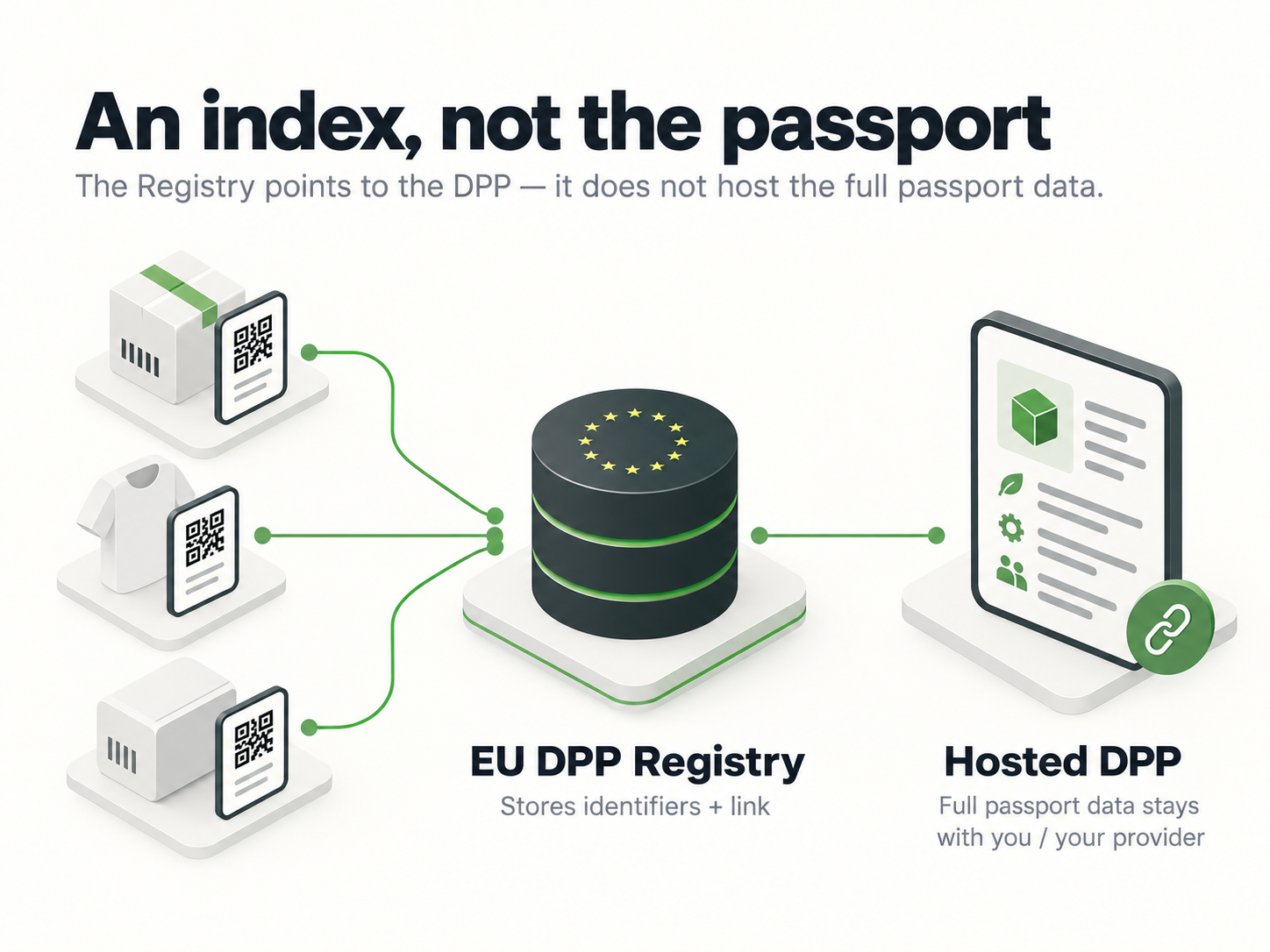
This does not mean that every complete passport must be uploaded and permanently stored in a single public EU database. A DPP may be hosted separately, while the registry records the information necessary to identify and register it. The implementing rules also provide for the Commission to read DPP content during automated checks.
2. How does registration work?
-
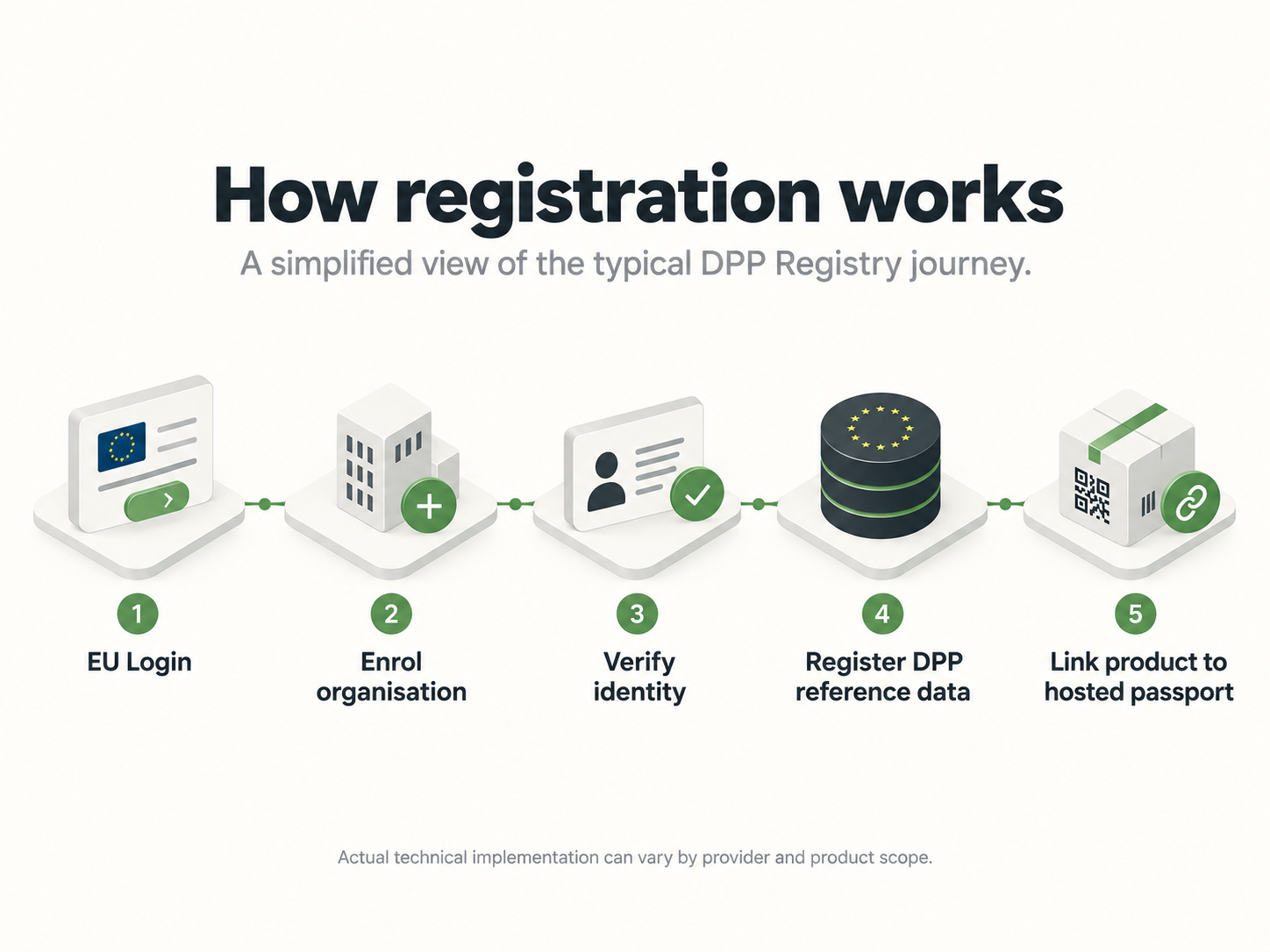
Verify
The economic operator or other permitted registrant follows the applicable identification and verification process.
-
Prepare
Create the DPP in accordance with product-specific rules, including the right identifier and model, batch or item granularity.
-
Submit
When the relevant registration function is available, submit the required registration metadata using the supported Registry interface or API. Check current access conditions and technical guidance before implementation.
-
Check
Depending on the released workflow and applicable requirements, the Registry can perform validation and relevant automated conformity checks. Consult the published data models and current system capabilities.
-
Receive ID
After successful registration, the registrant receives a unique registration identifier.
Important: Registration and evidence of registration are not equivalent to independent certification of the product or proof of compliance with every applicable product rule.
3. What data is involved?
Depending on the applicable legislation, registration can involve the following categories of data:
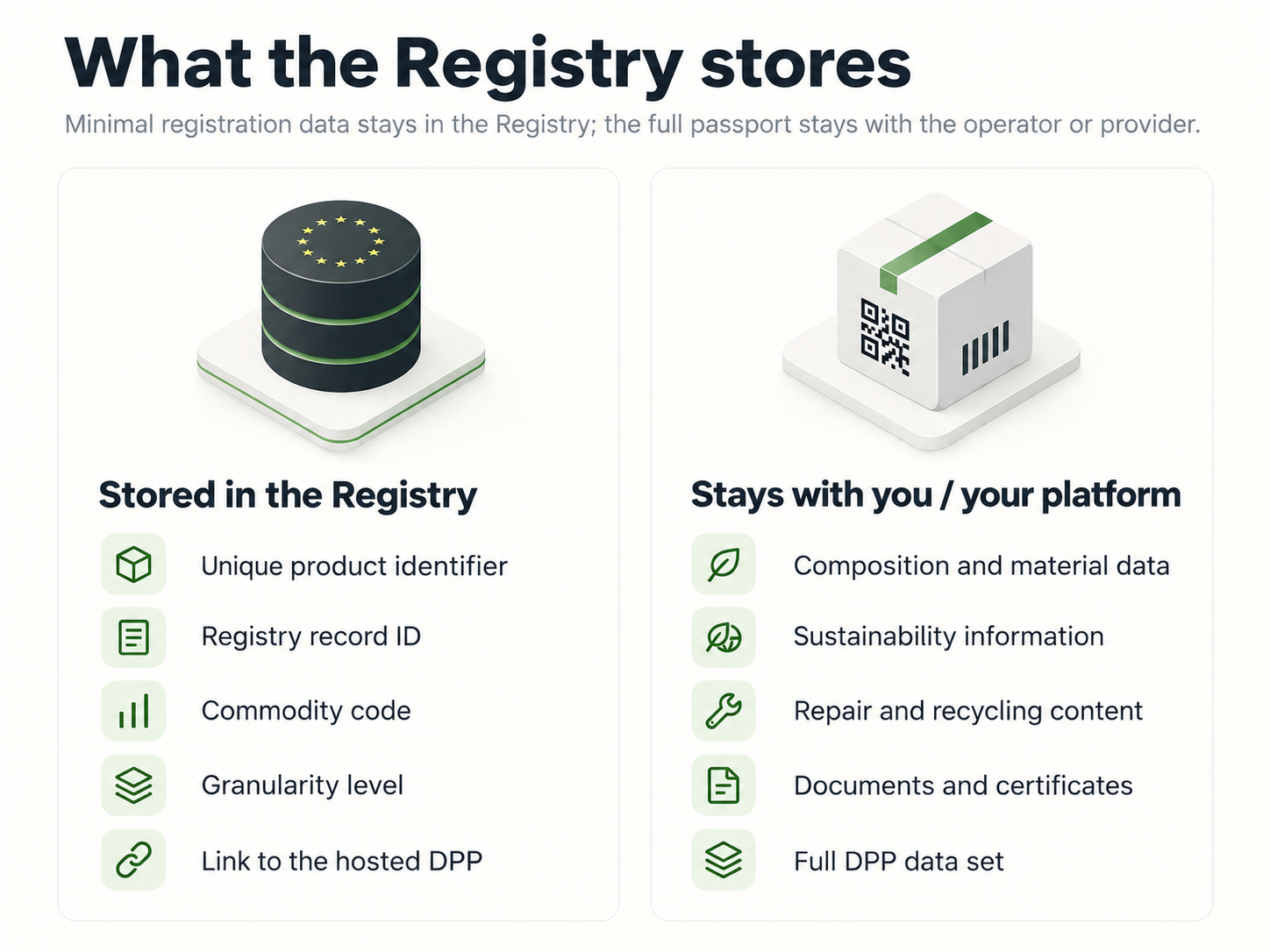
- Product identification: the unique product identifier and, where relevant, related identifiers.
- Commodity code: where relevant to customs processes.
- Granularity: registration at model, batch or item level, as required for that product.
- Actor information: details identifying the verified registering economic operator.
- DPP service provider reference: where relevant.
- Registration evidence: date and time, integrity information and the corresponding unique registration identifier.
A technical schema or mock API can be useful for engineering discussions, but field names from example implementations should not automatically be presented as mandatory fields of the production EU Registry. The authoritative requirements are those in EU law and the applicable product rules.
4. Registry and passport hosting: two connected layers
Passport host
The economic operator or a DPP service provider makes the product passport available and maintains the required product information, subject to the applicable rules.
EU DPP Registry
The EU-managed registry records relevant identifiers and registration information and supports verification, access management and registration evidence.
Conceptual architecture: the two layers are connected through identifiers and the specified registration and verification processes. It does not depict a published production API schema.
5. Why identity, authentication and authorisation matter
Two separate questions matter for a trusted DPP ecosystem: Who is making the request? (authentication), and what may that actor do? (authorisation). The Registry implementing rules set out identification, verification and access-management mechanisms for Registry users.
The distinction remains important beyond initial registration. For example, a repairer may need access to particular repair or service information in a passport, but that does not automatically grant the repairer permission to register a new DPP or change another operator’s Registry records. Runtime data access and update permissions must reflect the applicable product rules and technical architecture.
6. What is the link with customs?
The ESPR provides for customs checks involving the unique registration identifier and relevant commodity code. It also provides for an interconnection between the Registry and the EU Customs Single Window Certificates Exchange System (EU CSW-CERTEX). The relevant checks apply in accordance with the operational and legal conditions set out in the legislation.
7. What manufacturers should ask DPP platform providers
- Can the platform support the required product identifiers and model, batch or item granularity?
- How are economic operators identified, verified and granted appropriate permissions?
- What is the process for Registry registration, integration and handling API responses?
- How are updates, version history and data integrity maintained?
- How does the platform ensure passport availability, continuity and backup arrangements?
- What evidence can the company retain to demonstrate that registration was completed?
- Which capabilities are available today, which are on the roadmap, and which depend on future product-specific rules?
A practical platform assessment should distinguish demonstrated features from planned integrations. A visually appealing passport interface alone is not sufficient evidence of Registry readiness.
8. What to watch next
The framework is EU-wide, but implementation obligations are not identical for every product category on the same date. Businesses should follow the applicable delegated or sector-specific legislation, the Registry’s operational documentation, product-level identifiers and emerging technical standards.
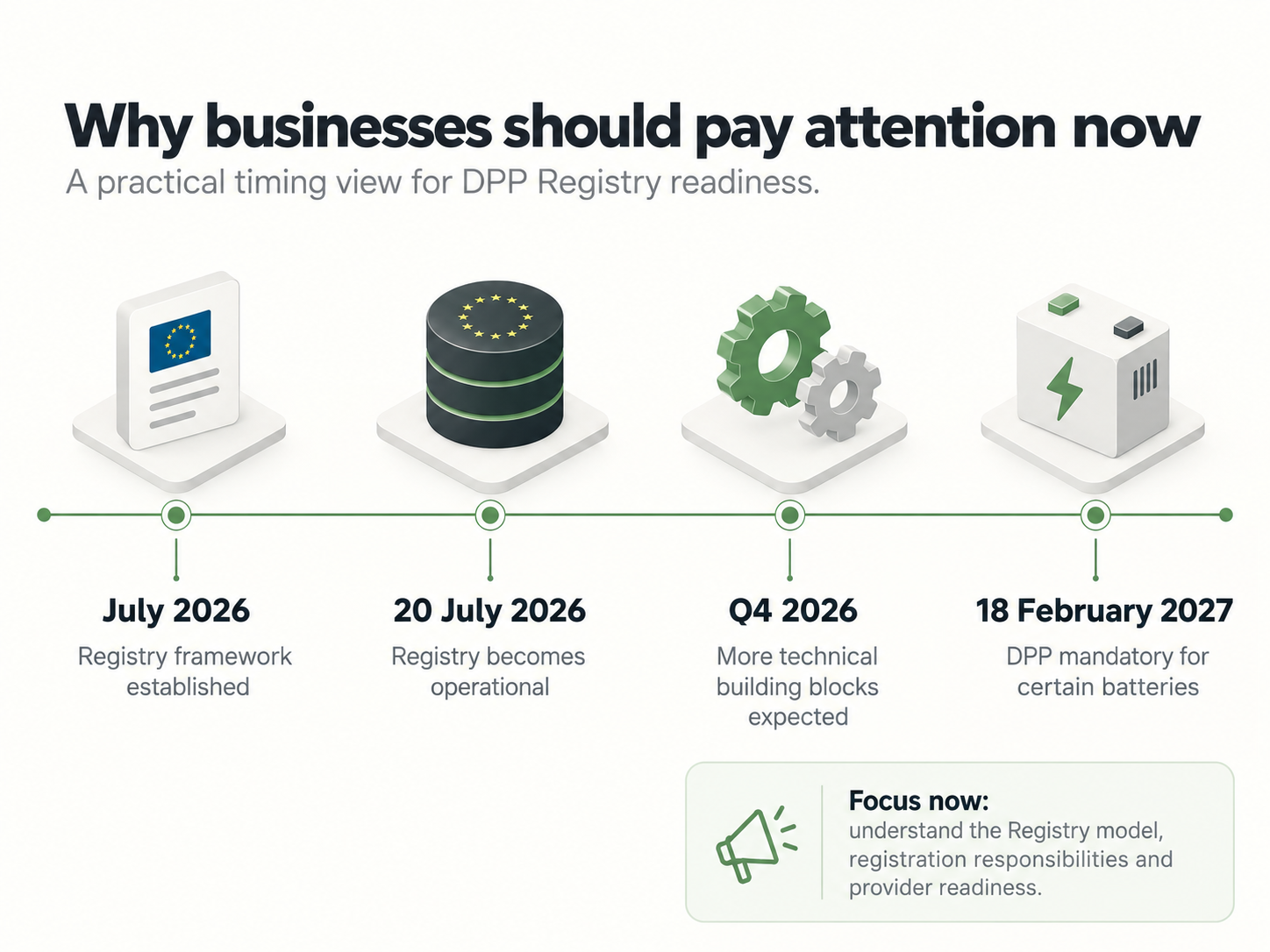
The Commission launched the Registry on 20 July 2026. Its published timeline identifies 18 February 2027 as the first passport requirement for relevant battery categories. These dates do not mean that every product group must register a DPP today. Verify the applicable product rules, technical guidance and available Registry functions before planning a production integration.
Conclusion: What OEMs and economic operators should do next
The next step is not simply to choose a DPP software platform. It is to establish who is responsible for registering each passport, which information must be submitted, and how the passport will remain accessible and maintainable over time.
Practical first exercise: Choose one representative product and test the available Registry workflow in the official testing environment. Document identity-verification steps, metadata, errors, corrections and proof of registration where these functions are available. This gives procurement and engineering teams a concrete basis for comparing DPP providers.
Official references and practical resources
EU legislation
- Regulation (EU) 2024/1781 — ESPR — Digital Product Passport framework; especially Articles 9–15.
- Commission Implementing Regulation (EU) 2026/1778 — Registry verification, access management, registration, data storage and technical arrangements.
Official Registry and implementation guidance
- European Commission — DPP Registry overview — official entry point for enrolment, testing, guidance and helpdesk.
- DPP Registry User Guide for Economic Operators (PDF) — step-by-step instructions on EU Login, organisation enrolment, verification and registration.
- EU DPP Registry — production portal — official secure Registry sign-in.
- EU DPP Registry — testing environment — explore available test workflows separately from production.
- European Commission — DPP resources and documentation — latest published user guides and technical materials.
- European Commission — Registry launch announcement (20 July 2026) — scope and intended functions of the Registry.
Documents, available platform functions and product-specific obligations may change. Check the official sources for the latest versions.

